
Space Scientists at SANSA
Space scientists play a vital role in understanding how the Sun and other cosmic activities affect Earth and the technology we use every day. From forecasting solar storms that can disrupt satellites and power grids to designing instruments that monitor near-Earth space, their work protects critical systems while expanding our knowledge of the universe. Meet some of the South African National Space Agency (SANSA) scientists leading the way:
- Salma Khan
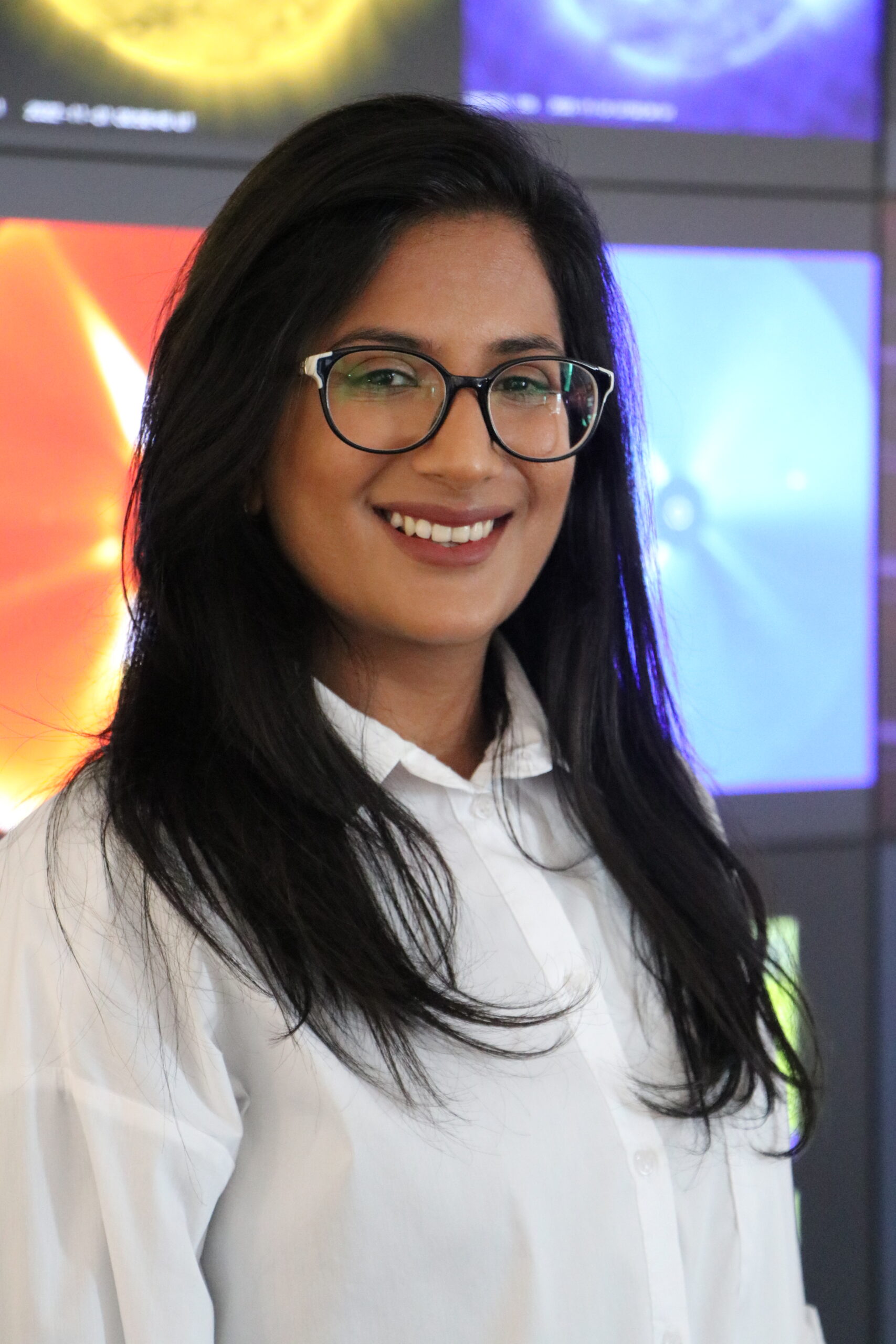
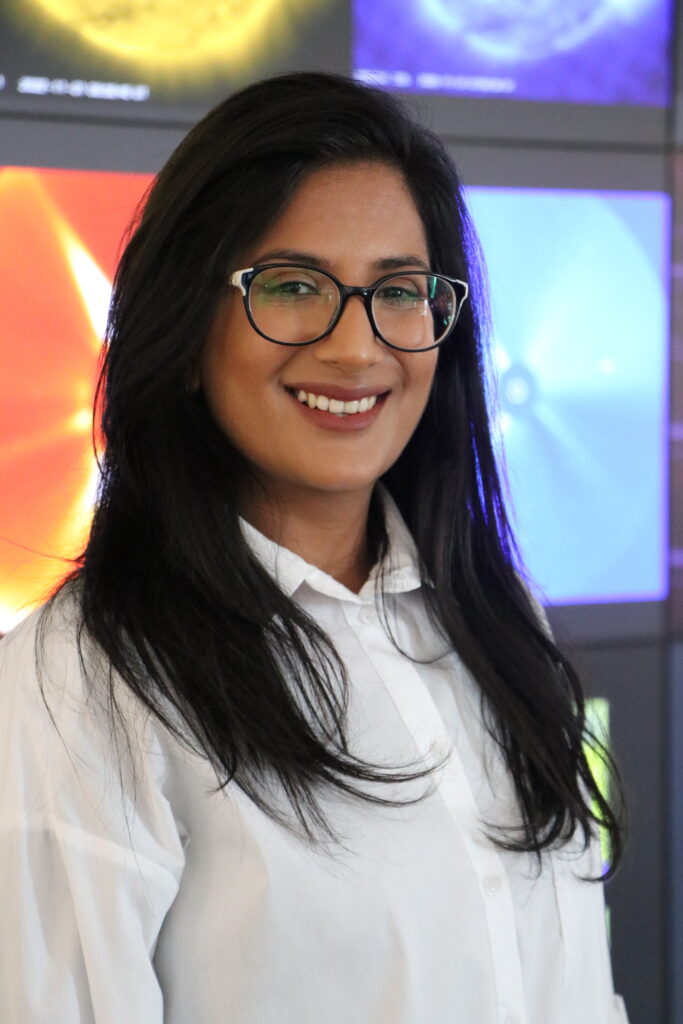
Salma Khan is a space weather forecaster at the South African National Space Agency (SANSA) in Hermanus, where she plays a vital role in monitoring and predicting solar activity that can impact Earth and its technologies. With a background in science and a passion sparked by the phenomenon of the Auroras, Khan is part of a growing field that studies how the Sun influences satellites, communication systems, aviation, and power grids.
1. Can you tell us about your role as a space scientist and the kind of work that you do?
My name is Salma Khan. I am a space weather forecaster working at the South African National Space Agency (SANSA) in Hermanus. Like terrestrial weather, the Sun can also have an impact on our Earth and space-based technological systems. So, I basically forecast the ‘weather’ in Space.
2 . What inspired you to pursue a career in space science?
My inspiration for choosing a career in Space Science started in my second year of university when I first heard about the Auroras. This sparked my interest as I realized the Auroras are linked to space weather.
3. What school subjects are most important for working in space science?
School subjects that are most important for working in space science are your general STEM subjects – particularly Mathematics and Science.
4. What kind of discoveries can space scientists make that affect our daily lives?
Space scientists, particularly space weather forecasters, are constantly monitoring, analysing, and forecasting space weather and therefore aid researchers in creating and/or upgrading models to improve methods to mitigate the impacts of space weather.
5. What advice do you have for someone who wants to be a space scientist?
Space weather in particular has an impact on a wide range of industries, for example; Aviation, Energy, and Communications. It is, however, a niche field that still holds many unknowns. You just need to be passionately curious about Space Science and the impacts it has on our daily lives to work in this field.
- Boitumelo Makobe
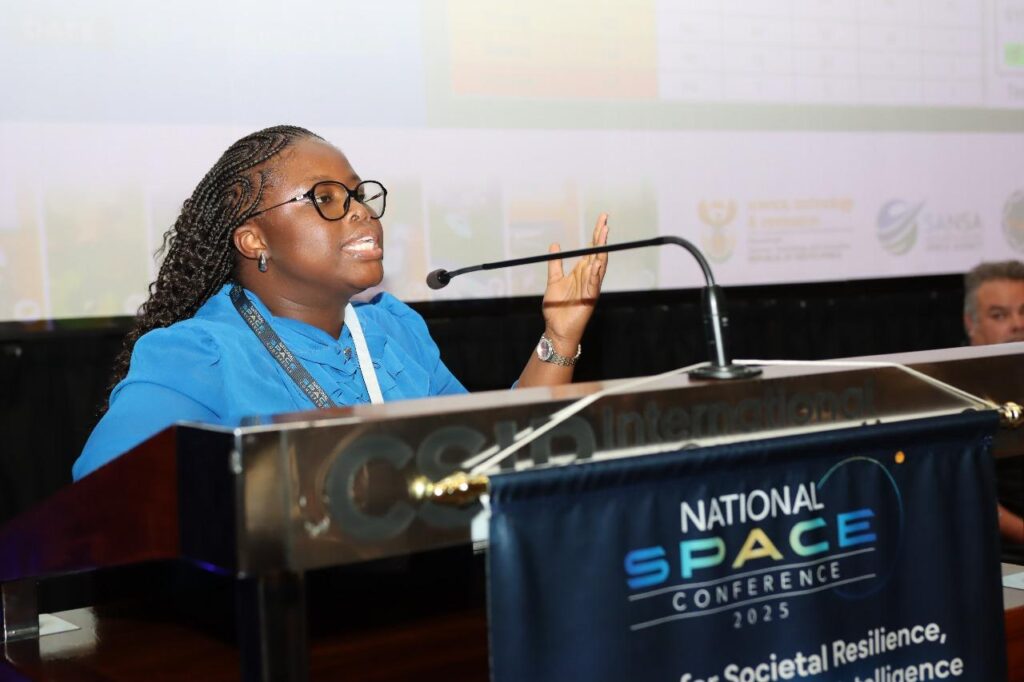
Boitumelo Makobe is a space weather forecaster at the South African National Space Agency (SANSA), where she is responsible for monitoring and predicting space weather conditions caused by solar activity. Her work plays a crucial role in protecting critical technologies, including satellites, GPS systems, and power grids, from the potentially disruptive effects of solar flares and geomagnetic storms.
1. Can you tell us about your role as a space scientist and the kind of work you do?
I am a space weather forecaster, and I am responsible for monitoring and forecasting space weather conditions. Space weather refers to how eruptions on the Sun can affect technological systems that we depend on daily, like satellites, GPS, and even power grids.
2. What inspired you to pursue a career in space science?
From a young age, I have always been curious about why clouds look the way they do and why some bring rain while others are drifting away. The curiosity later grew into a deeper desire to understand how everything around me works.
3. What school subjects are most important for working in space science?
Mathematics, Physics, Computer Science.
4. What kind of discoveries can space scientists make that affect our daily lives?
Space scientists can monitor and forecast solar flares and geomagnetic storms, which can affect radio communication, GPS signals, and satellite operations in space.
5. What advice do you have for someone who wants to be a space scientist?
Anyone interested in becoming a space scientist can start by taking STEM (Science, Technology, Engineering, and Mathematics) subjects. Don’t be afraid to ask questions and look for opportunities. Stay informed about the latest developments in the space industry, from new missions and discoveries to emerging technologies.
- DJ van Wyk
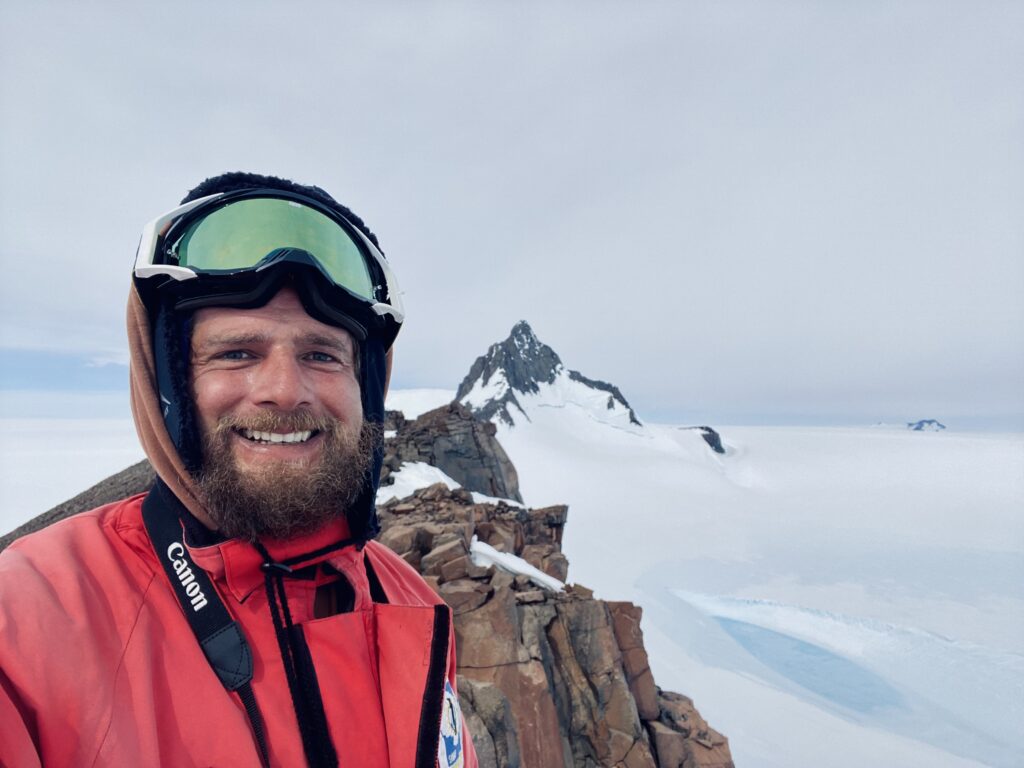
DJ van Wyk is a Development Engineer at the South African National Space Agency (SANSA), where he leads the Antarctic engineering team responsible for radar systems and space physics infrastructure. He has a background in embedded systems, radar instrumentation, and data acquisition systems. His PhD research with Stellenbosch University focuses on the development of Synthetic Aperture Radar (SAR) payloads, SAR image processing, and the integration of SAR and GNSS data for geophysical applications. He also has years of field experience in Antarctica, supporting space science and geospace research.
1. Can you tell us about your role as a space scientist and the kind of work you do?
As a space systems development engineer at SANSA, I lead projects focused on the design, deployment, and maintenance of radar and GNSS systems used in space physics and near-Earth space science research. My team develops and operates scientific instruments that collect data to help us understand how space weather and geophysical processes affect Earth. This includes managing radar systems in Antarctica and South Africa, developing data acquisition and automation software, and ensuring continuous data delivery for researchers globally.
2. What inspired you to pursue a career in space science?
I’ve always been interested in anything and everything related to outer space and aerospace, with the idea of exploring beyond our planet fascinated me for many years. Over time, I became captivated by how radio signals provide a window into space, revealing so much about the space environment and our planet’s interaction with it. This intersection of engineering and discovery is what inspired my journey into space science. My current PhD research focuses on advancing technologies for space-borne systems, contributing to the broader engineering field through the development of radar payloads for small satellites, and innovative data integration techniques that enhance our ability to study and monitor Earth from space.
3. What school subjects are most important for working in space science?
Mathematics and Physical Science are the most important foundations for a career in space science. Mathematics teaches problem-solving and analytical thinking, which are essential for understanding orbital mechanics, signal processing, and system design. Physical Science builds an understanding of how forces, energy, and materials behave, which is crucial when designing systems that must operate reliably in extreme environments like space or Antarctica.
At the university level, these foundations expand into subjects such as Electromagnetics, Digital Signal Processing, Control Systems, Antenna Theory, Embedded Systems, and Radar Engineering of which are all vital to understanding and building space-borne instruments and scientific payloads. Ultimately, strong fundamentals in maths, science and physics open the door to engineering and science disciplines that make space exploration possible.
4. What kind of discoveries can space scientists make that affect our daily lives?
Space scientists and physicists study how solar activity interacts with Earth’s magnetic field and upper atmosphere, shaping a dynamic system known as space weather. Understanding these processes helps us predict and mitigate space weather events that can disrupt GNSS systems, communication networks, aviation routes, and even power grids. At SANSA, our teams design, operate, and maintain scientific instruments that monitor the near-Earth space environment, which are done with various types of instruments from radars and magnetometers to GNSS receivers and satellite sensors. The data collected through this research supports national and international efforts to safeguard technology-dependent systems and improve models used for forecasting and navigation.
5. What advice do you have for someone who wants to be a space scientist?
Stay curious, be willing to experiment, and don’t be afraid of failure. Every great discovery starts with trial and error. Build a strong foundation in maths, physics, and programming, but also work on practical projects and experiments in the field. Space science is a multidisciplinary field that rewards creativity and teamwork, so explore broadly and find what excites you most. The path may be challenging, but it’s worth every step.
The South African National Space Agency (SANSA) offers post-graduate bursaries in space-related fields for high-achieving and driven students.
Applications open in May for the following academic year. Follow the South African National Space Agency on LinkedIn, Facebook, and X to make sure you do not miss this opportunity.